VANCE CLADER
VANCE CLADER
Lifelong vs. Acquired PE: What Each Type Actually Looks Like (And Why the Fix Must Be Completely Opposite)
Premature Ejaculation (PE) isn’t one problem — and that’s the exact reason so many men stay stuck.
Some men have Lifelong PE (it’s been there since their first sexual experiences).
Others have acquired PE (it developed later in life, often suddenly).
Most men don’t know which type they have.
And that matters — because the treatment approach for each type is completely opposite.
If you try the wrong one, you see no progress… or get worse.
This guide will show you:
What lifelong PE actually looks like
What acquired PE actually looks like
Why are the fixes total opposites
The simplest way to tell which one you have
Let’s break it down clearly — without the internet confusion or the “one-size-fits-all” nonsense.
What Most Men Get Wrong About PE
Almost every guy starts with the same Google searches:
“Why do I finish so fast?”
“Is there a trick to lasting longer?”
“Can I train myself to last 30 minutes?”
“How do I stop premature ejaculation naturally?”
And all the answers online assume PE is just one issue… with one generic solution.
But after working with thousands of men, there’s one truth I’ve seen again and again:
👉 PE is a pattern — and not all patterns are the same.
👉 You can only fix it once you identify the specific pattern you have.
This is where most men take a wrong turn.
Lifelong PE: What It Actually Looks Like
Lifelong PE (also known as “primary PE”) means:
You’ve had trouble controlling ejaculation from your earliest sexual experiences — usually since your teens.
Common Patterns of Lifelong PE
Most men with lifelong PE experience:
Ejaculation within seconds or under a minute
A feeling of no control whatsoever
The “urge to finish” kicks in immediately
Difficulty slowing down once aroused
A body that reacts faster than the mind
PE is happening every time, with every partner
This type of PE is usually rooted in:
A hyperactive nervous system
A tight or reactive pelvic floor
An early arousal pattern that became “wired in.”
Learned tension responses from teenage habits
It’s not about sensitivity.
It’s not about hormones.
And it’s definitely not about “being broken.”
What Lifelong PE Feels Like
What Lifelong PE Feels Like
If you have lifelong PE, you probably feel like your body is:
Too fast
Too reactive
Too tense
Hard to slow down once touched
Even when you’re calm mentally, your body can jump into high alert in seconds.
Why Lifelong PE Needs a Specific Solution
Lifelong PE can almost never be fixed with:
Kegels
Numbing sprays
Thick condoms
Distractions
Mental tricks
Porn detox
“Think of something else,” advises
Why?
Because lifelong PE is body-driven, not mind-driven.
The solution is retraining:
Your pelvic floor
Your arousal curve
Your nervous system
Your stimulation response
The key is slowing the body, not forcing more mental willpower.
Acquired PE: What It Actually Looks Like
Acquired PE (also called “secondary PE”) is completely different.
This type shows up later in life — sometimes suddenly, sometimes gradually — after a period of normal sexual control.
Common Patterns of Acquired PE
Men with acquired PE often experience:
PE happens only after stress or life changes
Great control in the past → sudden loss now
Anxiety that shows up around sex
Overthinking during intimacy
Difficulty staying present
Trouble getting or staying hard + finishing too fast
Cycles of “I hope this time I don’t finish fast.”
Unlike lifelong PE, acquired PE is usually triggered by:
Stress
Anxiety
Performance pressure
Relationship tensions
Porn-induced expectations
Erectile dysfunction fears
Major life changes (job, health, parenting, etc.)
What Acquired PE Feels Like
If you have acquired PE, it often feels like:
Your mind is the problem, not your anatomy
You’re thinking too much during sex
Your body is “rushing” because of internal pressure
You’re afraid of disappointing your partner
Your performance anxiety spikes at the worst time
This type isn’t driven by a fast body — it’s driven by a fast mind.
Why Acquired PE Needs the Opposite Treatment
Here’s the key:
Lifelong PE needs body training.
Acquired PE needs mental + emotional resetting.
If you give acquired PE the wrong exercises — like intense pelvic floor training — it often gets worse.
If your PE is anxiety-driven or performance-based, then:
Kegels don’t help
Edging can increase pressure
Numbing sprays don’t solve the issue
“Just relax” never works
The fix is:
Nervous system downregulation
Confidence rebuilding
Anxiety restructuring
Partner communication skills
Realistic arousal pacing
Removing performance pressure
Acquired PE is solved from the top down — mind → body — not the other way around.
Lifelong vs. Acquired PE: Why the Fix Must Be Completely Opposite
If you treat lifelong PE with anxiety tools, you get nowhere.
If you treat acquired PE with pelvic drills, you get frustrated.
The two types respond differently because:
One is physical
One is psychological
One is rooted in early wiring
One is triggered by life events
Trying the wrong fix creates:
More tension
More frustration
More self-doubt
More confusion
And for many men, this is why they say:
“I’ve tried everything — nothing works.”
They haven’t tried everything.
They’ve tried everything that wasn’t meant for their type.
How to Tell Which Type You Have (Quick Self-Test)
Ask yourself one question:
“Did I always have this problem… or did it start later?”
If you've had PE since your earliest experiences → Lifelong PE
Look for:
Under 1 minute consistently
Almost zero control
Immediate urge to finish
PE with every partner
PE even when calm
If you developed PE after a period of normal control, → Acquired PE
Look for:
Normal stamina in the past
Recent stress or anxiety
Loss of control only during sex
Overthinking during intimacy
Performance anxiety
The Path Forward: Know Your Type → Fix the Right Pattern
You’re not broken.
You’re not stuck.
You’re not “too sensitive.”
You simply haven’t been shown the approach that matches your type.
That’s exactly why I wrote “Last 30 Minutes or More” — a free guide that walks you through:
A clear diagnosis
The differences between types
Exactly what causes your pattern
The specific exercises and strategies that work for your type
What to avoid so you don’t make it worse
You can download it for free on my website.
No shame.
No judgment.
Just the clarity I wish someone had given me years earlier.
Once you know your type, the guesswork disappears — and real progress finally begins.
-Vance Clader.
Join the Clader Method Newsletter
Actionable tips, science-based strategies, and exclusive trainings to help you control your performance — naturally.
Connect on



A Simple, Science-Backed Method to Master Control and Boost Your Confidence.
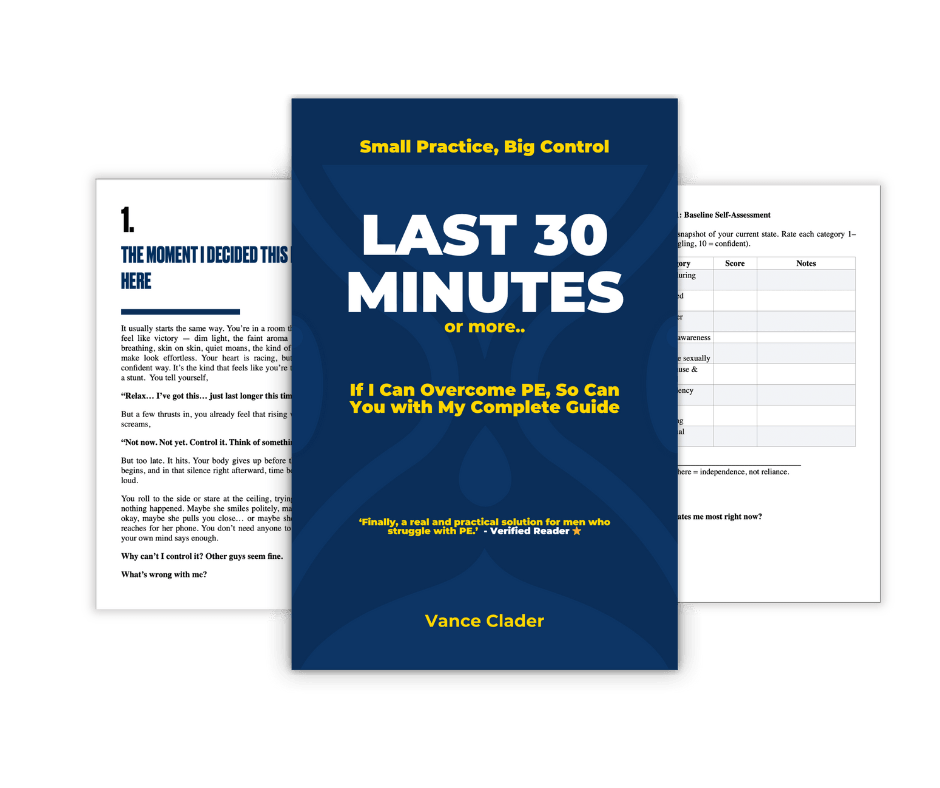
Download Part 1 of the Last 30 minutes (or more).
#1 Guide to Overcome PE.
Packed with practical techniques and awareness strategies, Last 30 Minutes or More will teach you how to master control and build lasting confidence through simple, proven steps.
Legal notice
Cookies policy
Privacy Policy
Terms of use
©Clader method. powered by people.